
Fayette County Wanted Fugitives Source
Fayette County keeps warrant records in one spot. The Fayette County Sheriff's Office active-warrant search is the official public source for the county. Anyone can query it by name. See what comes back. The sheriff calls each entry possibly active, and that wording matters. A warrant listed today could already be served. It might have been recalled, quashed by a judge, or amended since the last update.
There is no ranked most-wanted roster. No wanted count, no portraits, no posting schedule, and no "Warrant Wednesday" feature. Issue dates in the inventory reach far back in time. So treat what you find as a starting point, not a current priority list. A name match is just a lead. Confirm it through official channels.
The official interface is shown in this capture from the sheriff's warrant search.
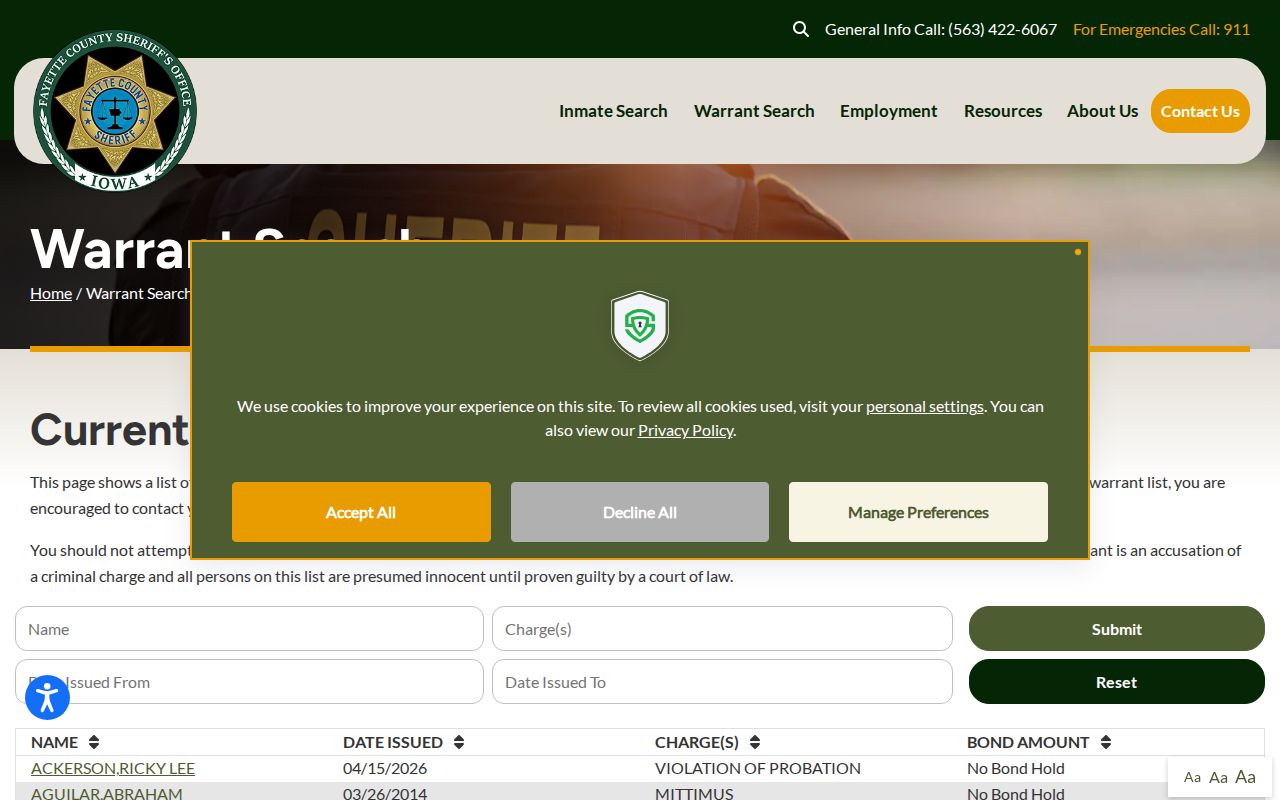
The portal's controls and warnings tell the story plainly. This is a warrant check tool, not a picture-driven most-wanted gallery.
Fayette County Warrant Record Fields
A search here has two halves. First come the filters you type in. Then come the fields that describe any matching warrant record. The results speak only to a possibly active warrant. They say nothing about whether an arrest happened, whether the person sits in jail right now, or how a charge was resolved.
| Field | What it shows |
|---|---|
| Name | The name attached to the possibly active warrant record. |
| Date issued | When the warrant was issued, which may be much earlier than the search date. |
| Charge | The alleged basis shown with the warrant, not a court disposition. |
| Bond | The amount in the inventory, subject to current official confirmation. |
| Photo | None. The public Fayette County interface publishes no portraits. |
You can filter by name, by charge, and by issue date. Use a start date, an end date, or both. Date ranges help sort the inventory, but they prove nothing about enforceability. A search that returns nothing is not proof that no warrant exists. Spelling variations, timing, agency records, and later court action can all shape what the portal shows.
Note: Results describe possibly active warrants and should never be treated as a jail list.
Check a Fayette County Warrant
Begin at the official county portal. Then confirm any apparent match through a second official channel before acting on it. This two-step approach cuts down on mistaken identity and stale information. It also keeps the focus where it belongs: lawful verification and resolution.
- Open the sheriff's active-warrant search and enter the name. Add a charge or issue-date range only when that detail is known.
- Compare the displayed name, issue date, alleged charge, and bond. Do not assume a name alone identifies the right person.
- Contact the sheriff or court to confirm whether the warrant remains active. Do not act solely on the web result.
- If the warrant may concern you, contact an attorney or the proper court and ask how to address it safely.
- Use Fayette County's custody and booking-record paths only to answer a different question: whether an arrest and jail booking followed.
Why does the last step matter so much? The inventory reflects a pre-arrest, possibly active stage. Someone booked at the Fayette County Correctional Center may show up on its current-custody roster while held there. A person released quickly may vanish from that same roster within hours. Court records pick up the story from there, showing filings, amended charges, dismissals, pleas, judgments, and any later orders.
Fayette County Warrant Types
The portal lists a charge and an issue date. That is all. Reading those fields to guess at a judge's reasoning is a mistake, since common labels can mark very different moments in a case. For the exact terms of any warrant, go to the court file or the issuing office. Both are sounder sources than a public search page.
| Type | General meaning | Safe next step |
|---|---|---|
| Arrest warrant | A judicial order authorizing arrest based on an charge and required findings. | Confirm with the issuing court or law enforcement, then seek legal advice. |
| Bench warrant | An order often tied to a missed court duty or another event in an existing case. | Contact counsel or the clerk for the case-specific route. |
| Outside-agency warrant | An order from another jurisdiction that may affect local custody. | Verify both the listed agency and the issuing court. |
A current docket beats an old screen capture. Bond amounts and charge descriptions can shift as a case moves forward. Check the live record. Do not trust a saved image of the past.
Fayette County Warrant Tips
Know where a fugitive might be? Tell law enforcement. Fayette County publishes no dedicated warrants-unit line, no anonymous Crime Stoppers portal, and no verified reward program with posted terms. Promising a caller anonymity or payment would be misleading, because the sheriff has announced no such system. Keep expectations plain: report what you know, and let officials handle the rest.
Fayette County Sheriff's Office220 N Industrial Parkway
West Union, IA 52175
General and non-emergency: 563-422-6067
Office hours: Monday through Friday, 8:00 a.m. to 4:00 p.m., excluding holidays
Call 911 only for a true emergency. For anything less urgent, use the sheriff's published general line. Never confront, accuse, or act against a person based on a web entry alone.
Note: The county promises neither anonymity nor rewards, so assume neither applies to your call.
Verify Fayette County Warrant Status
The sheriff's inventory and the court docket answer two different questions. The portal flags warrants that may still be active. Iowa Courts Online then follows a public case through its filings and final disposition. New cases can take one business day to appear in the court index, and updates happen in real time after that. Even so, the web index is not the official court record.
For certified answers, turn to the Fayette Clerk of Court. The office sits at 114 N Vine Street, Suite 200, West Union, IA 52175. Call 563-422-5694. Hours run Monday through Friday, 8:00 a.m. to 4:30 p.m. Some documents require a courthouse terminal or a subscription, and juvenile or confidential matters stay out of public view.
If a search turns up your own name, do not test enforcement or dodge contact. A lawyer can confirm the issuing case and help you respond lawfully. Court staff can explain filing and appearance procedures, though they cannot give legal advice. Those routes beat posts, screenshots, or a third party's claims every time.
Fayette County Alert Limits
Fayette County, Iowa has no official sheriff mobile app. Searches in the app stores tend to surface namesake programs from Ohio or Pennsylvania instead. Those serve their own counties. The local sheriff's website and Facebook page post safety notices from time to time, but neither works as a full warrant list or booking-photo feed.
Alert Iowa and Smart911 handle emergency and community alerts. They do not verify active warrants or publish wanted portraits or jail bookings. IowaVINE covers a different niche, sending custody-status notifications for Iowa jail and corrections cases. It is neither a public warrant database nor a mugshot archive.
Knowing these limits prevents false matches. Quiet on social media does not clear a warrant. An app bearing a similar county name proves nothing about a Fayette record. Start at the sheriff's official portal, then confirm any match with the sheriff, a lawyer, or the court.
Fayette County Accusation Notice
Warrants change. Charges can be amended or dropped, and a warrant itself can be served, recalled, or quashed. So anchor anything you say to a date and a source. "The sheriff's portal showed a possibly active warrant on the date checked" is accurate. "Convicted," "jailed," or "currently wanted" is not, unless a current official record backs that exact statement.
Identity takes the same care. The public results carry no portrait or full physical description, so a shared or similar name can create real doubt. Compare the issue date and the charge. Then let the sheriff or the court confirm the record. Skip social media, old news items, and people-search sites when filling in the gaps.
Keep status labels precise too. "Possibly active" is the sheriff's own wording. "In custody" demands a current jail source. "Convicted" demands a court result. Holding those terms apart keeps the Fayette County record honest.